Here We Go Again More Port Authority Proposed Fare Hikes
Sectional: The scapegoating of Russia has taken on an air of discrimination and ugliness, based largely on Cold War-era stereotypes. In this article, Natylie Baldwin counters this intolerance with some of her positive impressions having traveled the land extensively.
By Natylie Baldwin
Over the last twelvemonth and a half, Americans have been bombarded with the Gish Gallop claims of Russiagate. In that time, the almost reckless comments have been fabricated against the Russians in service of using that land equally a scapegoat for problems in the United States that were coming to a head, which were the real reasons for Donald Trump's upset victory in 2016. It has even gotten to the point where irrational hatred confronting Russian federation is becoming normalized, with the usual organizations that similar to warn of the pernicious consequences of bigotry silent.
 The first time I realized how depression things would likely get was when Ruth Marcus, deputy editor of the Washington Postal service, sent out the post-obit tweet in March of 2017, squealing with please at the idea of a new Cold War with the world's other nuclear superpower: "So excited to exist watching The Americans, throwback to a simpler fourth dimension when everyone considered Russian federation the enemy. Fifty-fifty the president."
Not only did Marcus's comment imply that it was great for the U.S. to have an enemy, merely it specifically unsaid that in that location was something particularly great about that enemy being Russia.
Since so, the public discourse has only gotten nastier. Former Director of National Intelligence James Clapper – who notoriously perjured himself before Congress about warrantless spying on Americans – stated on Meet the Printing last May that Russians were uniquely and "genetically" predisposed toward manipulative political activities. If Clapper or anyone else in the public middle had fabricated such a statement virtually Muslims, Arabs, Iranians, Jews, Israelis, Chinese or just near any other group, at that place would have been some push-back most the prejudice that it reflected and how information technology didn't correspond with enlightened liberal values. But Clapper'due south comment passed with hardly a peep of protestation.
More recently, John Sipher, a retired CIA station principal who reportedly spent years in Russia – although at what betoken in time is unclear – was interviewed in Jane Mayer's recent New Yorker piece trying to spin the Steele Dossier every bit somehow legitimate. On March 6, Sipher took to Twitter with the post-obit comment: "How can one not exist a Russophobe? Russia soft power is political warfare. Difficult ability is invading neighbors, hiding the death of civilians with chemical weapons and threatening with doomsday nuclear weapons. And they kill the opposition at home. Name something positive."
In fairness to Sipher, he did backpedal somewhat after being challenged; however, the fact that his unfiltered blabbering reveals such a deep antipathy toward Russians ("How tin can one not exist a Russophobe?") and an initial supposition that he could go away with saying it publicly is troubling.
Glenn Greenwald re-tweeted with a comment asking if Russians would soon acceptably be referred to as "rats and roaches." Another person replied with: "Because they are rats and roaches. What'south the problem?"
This is only a small-scale sampling of the anti-Russian comments and attitudes that pass, largely unremarked upon, in our media landscape.
There are, of course, the larger institutional influencers of civilization doing their part to push anti-Russian discrimination in this already contentious temper.Red Sparrow, both the book and the movie, detail the escapades of a female Russian spy. The story propagates the continued fetishization of Russian women based on the stereotype that they're all hot and frisky. Furthermore, all those who piece of work in Russian intelligence are evil and backwards rather than possibly being motivated by some kind of patriotism, while all the American intel agents are paragons of virtue and seem like they but stepped out of an advertizing for Nick at Nite's How to be Swell.
The recent Academy Awards connected their politically motivated trend of awarding Oscars for best documentary to films on topics that simply happen to coalesce nicely with Washington'due south latest adversarial policy. Last year information technology was the White Helmets film to support the regime alter meme in Syrian arab republic. This year it's Icarus virtually the doping scandal in Russia.
Similarly, Loveless, the new film by Russian director Andrey Zvyagintsev (managing director of Leviathan) is being reviewed – every bit Catherine Chocolate-brown points out – past writers from the mainstream American media in a predictably biased fashion. The film focuses on the disintegration of a married Moscow couple'southward relationship and the complicated spider web of factors involved which take tragic ramifications for the couple's 12-yr quondam son.
American reviewers manage to paint the factors detailed in the film that are prevalent in near modern capitalist cities (eastward.g. being self-centered, materialistic and preoccupied with technological gadgets) equally somehow uniquely Russian sins. They too ignore a prominent character in the film that defies their negativity most modernistic Russia – a character that represents altruism and the growth of civil club in the country.
A common theme in all this is that Russia is a bad country and Russians can't help but be a bunch of skillful-for-nothings at best and dangerous deviants at worst. Indeed, according to media depictions, sometimes they manage to exist both at the same time. But what they don't manage to be is positive, constructive or fifty-fifty complicated. Sipher knows that the boilerplate American has been deluged with this anti-Russian prejudice, as reflected in his challenge at the finish of his initial tweet about the largest state, geographically at least, in the world: Proper name something positive.
Countering the Negative
Nearly people know, at least in the abstract, that few individuals or groups are purely good or bad. Most are a complex combination of both. Merely many – including those who normally consider themselves to be open-minded liberals – have allowed their lizard brains to be triggered by the abiding demonization of Russia in the hopes of taking down Trump whom they deem to be a disproportionate threat to everything they hold dear. And then as a counterweight to all the negative constantly pumped out about Russia and to take Sipher up on his challenge, I will list some positive things about Russia and the contribution of the country and its people to the globe.
Contemporary Russia'south Domestic Policy
Russian federation has ane of the most educated populations in the world, universal health intendance for its people, a home ownership charge per unit of 84%, strong gun control laws, no death punishment, 140 days of guaranteed motherhood leave for women at 100% salary, and Moscow was but voted the quaternary safest megacity in the world for women.
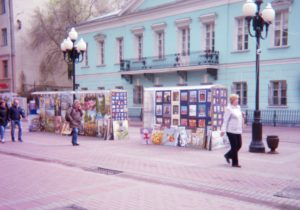
(Old) Arbat Street, Moscow; photo by Natylie Baldwin
And, despite claims that are ofttimes repeated in corporate media and even by many in the alternative press, Russia has independent and critical voices in the impress media. Even on boob tube, which is heavily influenced by the Kremlin, the Western position is often given airtime past either pro-Western Russian critics or Westerners themselves. During both of my visits to Russian federation (in 2015 and 2017) I interviewed a cross-department of Russians who all confirmed that they had admission to Western media through both satellite and the internet. Furthermore, while violence against journalists is a concern, according to the Committee to Protect Journalists, announcer murders accept decreased significantly under Putin compared to the era of Boris Yeltsin in the 1990s.
Am I saying that Russia is a utopia without any problems? No. Similar most countries, it has plenty. Near Russians, including Putin, admit this. These issues include still meaning poverty rates, comparatively low productivity and life expectancy, and corruption. But it is important to note the direction of trends, which are mostly positive since Putin took over. Nether his leadership, poverty rates have been cutting in half, life expectancy has increased by several years – especially among men who had suffered the worst mortality crisis since WWII, criminal offense has dropped, pensions have increased and are paid regularly, the unemployment rate has been around v% for years, great investments in infrastructure and agronomics take been seen along with evolution throughout the country.
And that development has not just been seen in Moscow and St. petersburg – the latter urban center which, past the way, culturally and architecturally rivals those in France and Italy.
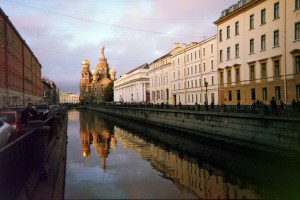
Church building on Spilled Blood, Leningrad; photo by Natylie Baldwin
There are plenty of medium-sized cities throughout Russia that are becoming well-developed and culturally engaging. Equally one example, during my 2015 trip, I visited Krasnodar, located in the Black Ocean region. The rate of civic construction in the city during 2014 surpassed fifty-fifty Moscow. As a consequence of the challenges of this rapid evolution, the public felt that decisions were not existence made with sufficient feedback from residents, several of whom got together and created a group called the Public Council which eventually found ways to become city authorities to listen to their concerns.
The grouping had received significant media attending, networked with youth groups and infrastructure specialists, and received strange experts in urban planning, public arts, transportation and metropolis marketing. They have as well organized periodic clean-up and renovation days, which are sponsored past local businesses that donate utilize of equipment. Currently, they are working on the creation of protected green zones, including one that connects all of the city'southward hiking paths and another to connect its 16 lakes. They have received no opposition from the Russian government and accept elicited the interest of other cities who desire to model their approach to local issues.
While in Krasnodar I met a dozen or more professionals, from lawyers to engineers and doctors, who lived in the city and were office of some other civic group engaged in charitable, conservation and youth programs. At one signal, I took a walking tour of the city. In terms of compages, I saw the old and the new side past side, including a large shopping center that was built around a large tower that had been there for generations that local residents saved from devastation by the mall planners, a square with controversial fountains, and a main thoroughfare that was closed to auto traffic, allowing pedestrians free reign. Couples – including some of mixed race, parents pushing infant strollers, and bicyclists – all wound their way through the streets every bit both Russian and American music was piped in and building walls on ane side of the street for a stretch displayed delicate illustrations of Russian history.
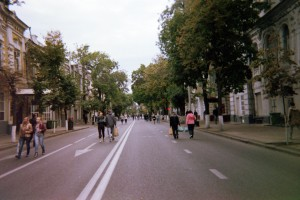
Pedestrian Thoroughfare, Downtown Krasnodar; photo by Natylie Baldwin
Fifteen hundred miles away in the Ural mountain region, the city of Yekaterinburg – named after Catherine I – has the infamous distinction of being the identify where Czar Nicholas Two and his family were massacred by the Bolsheviks in 1918. On the site where the family's bodies were exhumed, a magnificent Russian Orthodox Church has been erected and dedicated to the last regal family. Nearby is the Yeltsin Library, denoting the Russian federation'southward first President, although his legacy is not popular in Russia today.
The city is too home to a broad variety of precious metals and gems, forth with a thriving economy. Co-ordinate to Sharon Tennison, an independent program coordinator who has traveled there numerous times over the past fifteen years, hundreds of new apartment blocks can be seen on the outskirts of the urban center to adjust the recent economic and population growth.
Yekaterinburg has a bustling cultural life that includes an opera house, a ballet, numerous theaters and museums, as well as dozens of libraries. In this respect, the city has continued its preoccupation with the classical arts every bit in Catherine'southward period. At the same time, many modern Russian rock bands with a distinctive sound have formed there (known as Ural stone).
The city also has a low rate of violence and criminal offense.
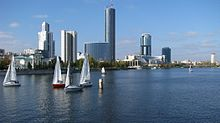
Yekaterinburg
As the New York Times and NPR like to point out and generalize out from, there are some rural and industrial areas in Russia that still need attention and investment. However, there are other towns in the countryside that are doing well.
Russian federation'due south Contributions to the Earth
Russia has fabricated many cultural and humanitarian contributions to the world. In the 18th and 19th centuries, royal Russia produced some of the about renowned figures in the world of arts. These include writers, such as Tolstoy and Dostoevsky, whose works are often cited by American readers as amongst the greatest of all fourth dimension; great composers include Tchaikovsky, Stravinsky and Rachmaninoff.
The state also has a rich history of pre-Soviet philosophers who debated questions of politics, history, spirituality and meaning. One of the nearly famous is Vladimir Solovyev, classified as belonging to the Slavophile school just distinguished from his boyfriend Slavophiles past his openness to and integration of several lines of idea.
He acknowledged the intuitive besides as the rational. He was friends with Dostoyevsky but had disagreements over Orthodoxy since Solovyev was an advocate of ecumenism and healing the schism between Orthodoxy and Catholicism. Furthermore, he is credited with influencing Nicolai Berdyaev, Rudolf Steiner and the Russian Symbolists, among others. He admired the Greek goddess Sophia who he characterized every bit the "merciful unifying feminine wisdom of God." Solovyev was skillful at integrating several spiritual strands, such as Greek philosophy, Buddhism, Kabbalah, and Christian Gnosticism.
Solovyev was famous for his debates with Slavophile contemporary, Nicolai Fedorov. In these and other writings, questions near morality and technological progress, how much humans should control nature, and prioritizing which bug to invest human'southward resource in solving were all given groovy consideration by Solovyev and are still relevant today, in both Russian club and the larger earth.
Information technology is interesting to notation that, of all the early Slavophile philosophers, Putin chose Solovyev, the one who was the to the lowest degree strident and most open to the synthesis of differing values and viewpoints, as function of his consignment of books for Russia's regional governors to read a few years back. Of course, that didn't terminate several western pundits – who showed they knew about zip of Solovyev but perhaps some cherry-picked and out-of-context tidbits they'd found online – from distorting his writings, which naturally had to be horrible because Putin recommended them.
Moving on to the 20th century, information technology should not be forgotten that the Soviet Union bore the brunt of defeating the Nazis during WWII, losing 27 million people, and saw a 3rd of their land destroyed in the process.

Front left of Monument to Siege of Saint petersburg, St. Petersburg; photograph by Natylie Baldwin
In the 21st century, Russian federation provided pregnant aid to Americans in the aftermath of Hurricane Katrina and Hurricane Sandy. They also provided safety ship to Yemeni-Americans out of that devastated country later the U.Due south. State Department effectively abased them in 2015. Russia provided medical aid to 60,000 people affected past the Ebola epidemic in West Africa in 2014. Last September, Russia provided 35 tons of aid to convulsion victims in Mexico.
For someone who spent years in Russia as a professional expert working for the U.S. intelligence community, John Sipher is either not well-informed on his subject or is intentionally being disingenuous when it comes to the suggestion that Russian federation has washed nothing positive, whether nether Putin's governance or before.
The Purpose of Scapegoating Russia
In early 2017, journalists Jonathan Allen and Amie Parnes published a book called Shattered: Inside Hillary Clinton'southward Doomed Campaign. Largely based on interviews with insiders from Hillary Clinton'south failed 2016 presidential campaign, the volume was an attempt to analyze why she lost. The insiders agreed that Clinton had trouble providing a plausible caption to voters as to why she was running other than that she only wanted to be president. They also noted her trouble connecting with boilerplate Americans and her failure to campaign in sure rust belt areas that Trump ultimately got support in. The book besides states that inside 24 hours of Clinton's loss, members of her campaign had decided to dwelling house in on the alibi of "Russian interference" to explicate away her humiliating defeat.
In improver to a bloc of Clinton's supporters continuing to push this excuse for her loss and the ratings motive that channels similar CNN and MSNBC accept in continuing to milk the scandal, at that place is also Robert Mueller's investigation which has dragged on for over a yr.
The near notable affair most the Mueller investigation to anyone who takes a sober look at it is its constantly evolving purpose. Start, the purpose of the investigation was to discover any testify to support the allegation that Russia had hacked into the DNC's emails. When no substantial evidence could be found to support that allegation, the purpose evolved into collusion between Trump and Russia to steal the election on behalf of Trump.
When no substantial evidence could exist plant to support that allegation, the purpose evolved nonetheless once more into Russia influencing the ballot on behalf of Trump, possibly without his cognition or participation. When no substantial evidence could be plant to support that allegation and all that could be found was a paltry number of social media ad buys – many of which were purchased after the election or advocated conflicting positions or didn't even take annihilation to exercise with the election, the purpose became "sowing discord."
Later on all of this, we have an indictment against 13 private individuals who worked for a "troll subcontract" that had been exposed several years ago and is run by a caterer with no proven orchestration by Putin or the Kremlin. Mueller also knows that this indictment will never be legally tested because the xiii individuals will never be extradited and stand trial.
After all the shrieking and howling 24/7 for shut to a year and a half that Trump was an illegitimate president installed by the Kremlin, this is the all-time Mueller and the mainstream Democrats can come up with. Information technology's pretty obvious by at present that this investigation has simply been feeding into the media and Democratic Party circus mentioned above rather than uncovering anything substantive with which to impeach Trump.
The 2016 ballot showed that the Democrats faced a sleeping behemothic that had been awakened – one that the Democratic Party had helped to create for decades by enabling lower living standards, outsourcing of good-paying jobs, the proliferation of low-wage jobs, unaffordable pedagogy, lack of wellness care coverage, public health bug, and decrepit infrastructure.
Consequently, there was a need for meaningful policies that would help average Americans, policies that polls show they want. But mainstream Democrats will not evangelize on such policies, like $15/hour minimum wage, Medicare for All, and pulling out of our wars and investing the coin saved in jobs and infrastructure. They won't evangelize on these things for the same reason that Republicans won't deliver on them: because their donors don't want them to. But they are not going to admit that to the American people who were going to go along demanding, and then they needed a scapegoat and a diversion.
It's a cheap fob that the political elite is using to appeal to the basest instincts of their beau Americans while shoring up support for their most reckless tendencies in the expanse of foreign policy.
Natylie Baldwin is co-writer ofUkraine: Zbig's Grand Chessboard & How the West Was Checkmated, available from Tayen Lane Publishing. Since October of 2015, she has traveled to six cities in the Russian Federation and has written several articles based on her conversations and interviews with a cross-section of Russians. Her fiction and nonfiction have appeared in various publications including Consortium News, The New York Journal of Books, The Common Line, and the Lakeshore. She is currently submitting her first novel to agents and finishing a second. She blogs at natyliesbaldwin.com.
Source: https://consortiumnews.com/2018/03/15/acceptable-bigotry-and-scapegoating-of-russia/
0 Response to "Here We Go Again More Port Authority Proposed Fare Hikes"
Post a Comment